

 Maintenance Connection Everywhere (MCe) · EAM/CMMS manuals
TL;DR
There are two places for setting up Files & Drives.
- On the server. For on-prem customers look at Files and Drives setup - Getting access for reading and writing. For SaaS customers, the options will have been set up for you.
- On your specific database.
Details
You can edit these in the Access Manager. It gives users of the system 'access' to the files in question.
Getting to Access Manager
The Access manager requires that you have rights to the "Access Manager" license. YOU decide what permissions it needs, not us, that is discussed elsewhere.) The Access Manager is on the Configuration page
Start by clicking on the main menu button on the left panel, top left portion.
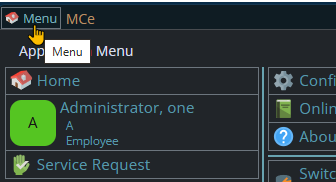
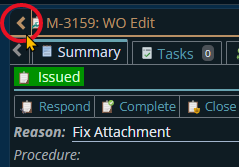
If the menu button isn't visible, you are likely on a screen too narrow to see everything, press on the left pointing gold button to take you so you can see the menu button.
Variation 1: What you have access to
Depending on the size of your screen, what products your company has purchased and what rights you have been granted, the choices in the menu will vary.
Variation 2: How wide your window is
The menu will show up as 1, 2 or 3 columns depending on how wide your screen is.
If you are on a cell phone, and some smaller tablets in portrait mode or a narrow window on a laptop or desktop, you'll see the menu as one column that you scroll through using your finger or the scroll wheel or the scroll bar depending on your device, browser and whether you have a touch screen or not.
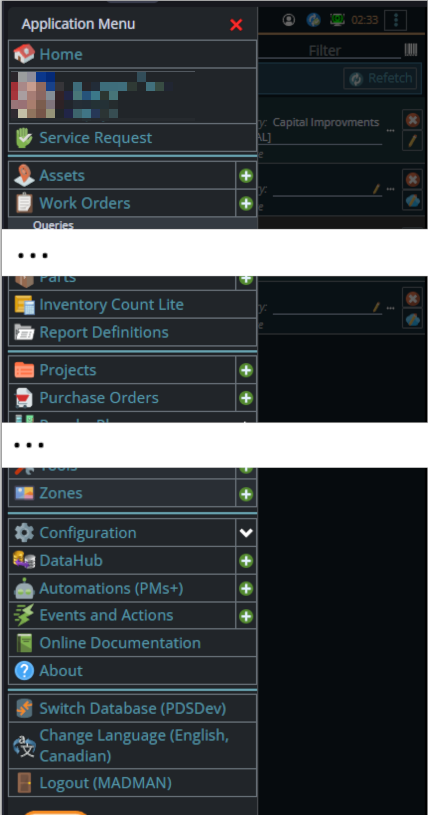
A bit wider, some cell phones in landscape, some tablets in portrait, most tablets in landscape and 'somewhat' wider laptop/desktop, will show it as 2 columns wide, with the middle column available on the left by scrolling down
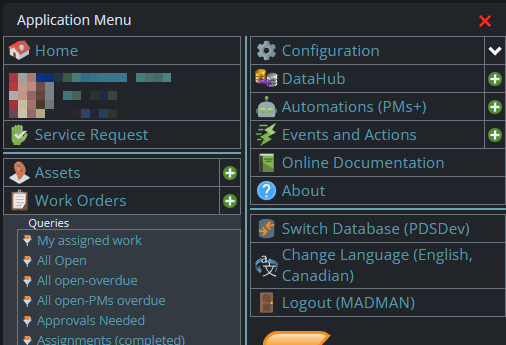
And wider screens, some landscape tablets, and wider windows on a laptop or desktop show it as 3 columns. If you have all the dropdown sections expanded, it may still require vertical scrolling to see all the choices depending on the height of your device or window.
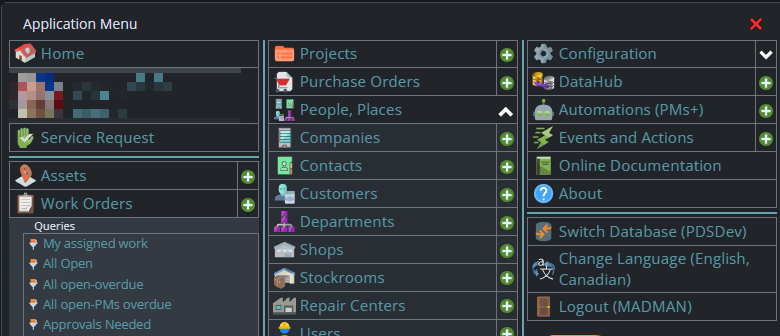
Once the menu is up, the exact location of the configuration button depends on how wide your window is and how many options you have access to. On most it will be at the top of the 2nd or 3rd column of the menu but on a cell phone or narrow window, it will be down partway in the first column.
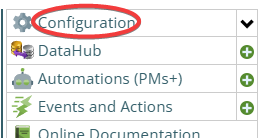
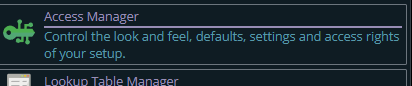
Then from there you choose the Access Manager, or what we call the funny green key
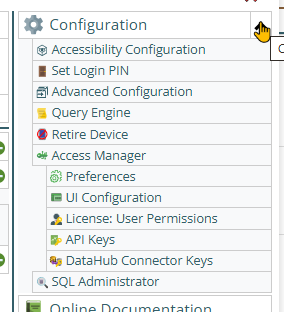
You can also click on the right hand V button in the main menu (if you don't already have it open), noting if you do it this way, you can directly pick the Access Manager tool that you want to go into.
Once you get to the Access manager, click on Files & Drives
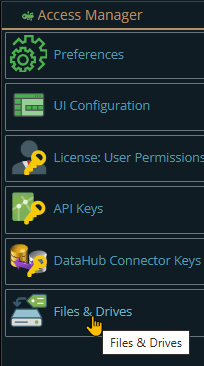
The list you see in the screen above may depend on what you have been given access to. If you don't see Files & Drives in the list, ask your IT or Super Admin if you can get access to the Files & Drives.
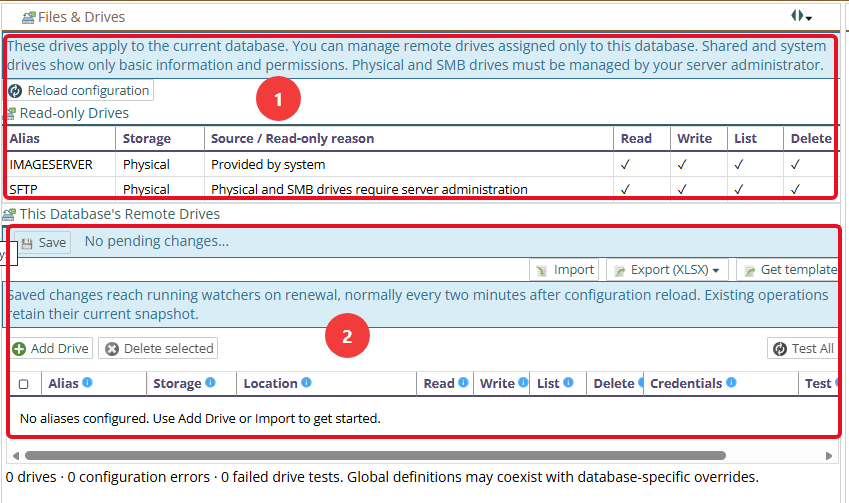
For security reasons, you can not edit or create any of the Physical drives from here. That must be set up at the server level. Setting it up here would be a huge security breach.
But you can set up SFTP (recommended) or FTPS (OK, but not best) and FTP (not secure). you would of course have to have an SFTP, FTPS or FTP server you have access to for reading and/or writing files before you can set them up.
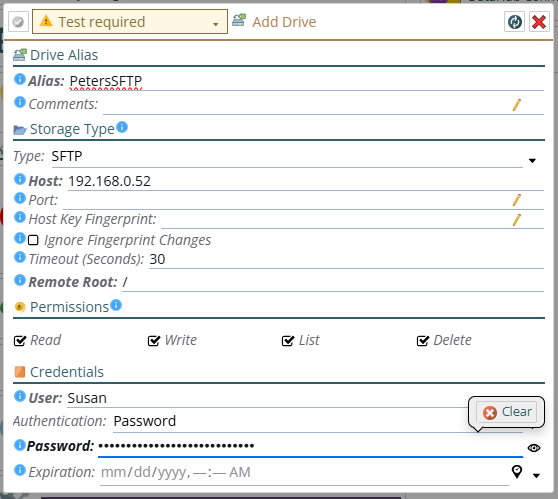
The alias is how you are going to access it in the rest of the system.
If you pick a different type, the questions will be slightly different depending on how that type works, what info it needs.
The type is currently SFTP, FTPS and FTP
The host is wherever the server is located - whoever set up the Host will tell you what the value is here.
There may be a port (if they aren't using the default SFTP port)
Often the Remote Root will be / meaning that you are giving access to everything your user account has access. Note this does not mean that you are accessing the root of the drive the files are on, it means you are accessing the root defined by the (in this case) SFTP server.
If you don't want this used past a certain date, enter it here.
When you are ready hit the test button
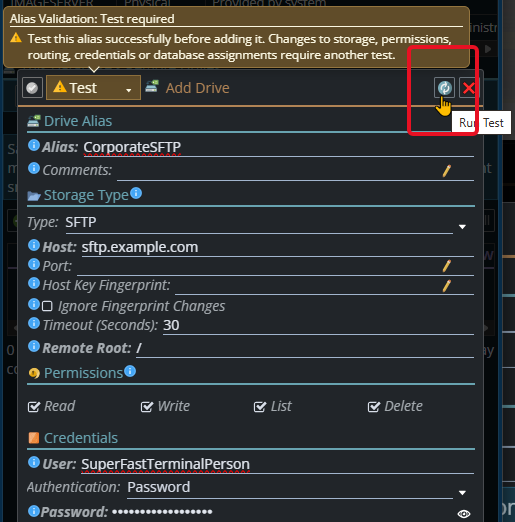
You will either get all green, or you will get one or more red. once you get all green you can save.
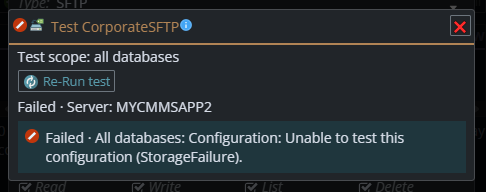
If the problem was at the FTP server end, then re-run test after fixing.
If the problem was with your setup - fix it then hit the run test button again.