
 Maintenance Connection Everywhere (MCe) · EAM/CMMS manuals
TL;DR
Choosing randomly (using a trustworthy random engine) is often a very poor choice for making selections for work.
The number of 'same in a row' or the number of 'why is this one "never" selected' is, for most people, surprisingly often.
Details
One of the interesting quirks of human psychology is that truly random sequences often don't feel random.
And ... because of this, when given a choice of 'random' or some other way to make a choice such as who should do the maintenance, random often doesn't result in what you were hoping.
When people imagine randomness, they tend to expect a sequence to look "mixed up" at every scale. If you ask someone to write down what they think 20 coin flips might yield, they might produce something like:
H T H T T H T H H T H T H T T H T H T H
This looks random to many people because heads and tails alternate frequently and there are no long runs.
But actual random sequences are messier. Real randomness naturally produces clusters, gaps, and streaks. A genuinely random sequence of 20 coin flips might look like:
H H H H H H T T H T T T T T T H H T H T
Many people look at this and suspect the coin is biased because of the six heads in a row and six tails in a row. In reality, streaks like these are exactly what randomness produces.
Why streaks are so common
Humans tend to underestimate how often runs occur.
Consider 20 fair coin flips. Many people intuitively think getting six or seven identical results in a row would be unusual. Yet it is surprisingly likely.
For a specific starting position, the probability of six heads in a row is:
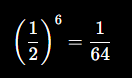
which seems small. But there are many opportunities for such a run to occur within 20 flips. When you account for all possible starting positions and both heads and tails, the chance of seeing at least one run of six consecutive identical outcomes in 20 flips is substantial—roughly one-third. The chance of a run of six or more is even higher. Runs of seven are less common but still far from rare.
This means that if you repeatedly flip a fair coin 20 times, you should expect to see a streak of six or seven identical results fairly often. It is not evidence that anything unusual is happening.
The "law of small numbers"
Psychologists sometimes describe this tendency as belief in the "law of small numbers." People unconsciously expect small samples to resemble the long-run average.
For example, because a fair coin produces 50% heads and 50% tails in the long run, people expect 20 flips to look nearly balanced and evenly mixed. But randomness doesn't work that way. Small samples are noisy. They routinely contain patterns that seem suspicious.
Casinos, sports, and the gambler's fallacy
This misunderstanding leads directly to the gambler's fallacy. Suppose a roulette wheel lands on black six times in a row. Many people feel that red is now "due."
But if the wheel is fair, no human cheating with a foot pedal or magnet for example, the probability of red on the next spin is unchanged. The wheel has no memory.
The streak feels non-random because people expect randomness to self-correct quickly. In reality, random processes don't smooth themselves out over short periods. The balancing only emerges over very large numbers of trials.
A paradox of randomness
The paradox is that:
- Sequences that look random to humans are often too evenly distributed to be truly random.
- Sequences that are actually random often contain surprising streaks and clusters.
In fact, if you generate a long list of random coin flips and remove all the long streaks because they "don't look random," you have usually made the sequence less random.
So when you flip a coin 20 times and see six or seven heads in a row, your intuition may tell you something strange has happened. Statistically, though, that streak is exactly the sort of thing that randomness produces all the time. The real surprise would be if every random sequence looked as evenly mixed as our intuition expects.
For 20 fair coin flips, the probability of getting at least one streak of 5 or more consecutive heads or tails is about: 45.8%
So it happens almost half the time.
Another way to say it:
- About 1 in 2.2 sequences of 20 flips will contain a run of at least five identical results.
- About 54.2% of sequences will not contain such a run.
To give some perspective:
| Longest run threshold | Probability in 20 flips |
|---|---|
| At least 4 in a row | ~75% |
| At least 5 in a row | ~46% |
| At least 6 in a row | ~25% |
| At least 7 in a row | ~13% |
| At least 8 in a row | ~6.7% |
| At least 9 in a row | ~3.5% |
| At least 10 in a row | ~2.1% |
This is one reason people are often surprised by randomness. A streak of five heads or five tails feels unusual, but in a sequence as short as 20 flips, it's actually close to a coin toss, conceptual pun intended, whether you'll see one, and if you had 50 people in a room, you expect there's a pretty good chance that one of them will flip 10 in a row the same. So even 10 in a row isn't all that rare.
For example, all of these are perfectly plausible 20-flip sequences:
HTTHTHHTHTTHHTHTHTTH(no run of 5)
HTHHHHHTTHTHTTHTTHHT(run of 5 heads)
TTHHTTTTTTHHTHTHTHHT(run of 6 tails)
Most people would instinctively think the last two look "less random," even though they are exactly the kinds of patterns that random processes produce regularly.
The probabilities drop off quickly as the streak length increases. For 20 fair coin flips, the chance of getting at least one run of kkk or more consecutive heads or tails is approximately:
| Longest run threshold | Probability in 20 flips |
|---|---|
| At least 10 in a row | 2.1% (about 1 in 48) |
| At least 11 in a row | 1.0% (about 1 in 100) |
| At least 12 in a row | 0.49% (about 1 in 204) |
| At least 13 in a row | 0.23% (about 1 in 435) |
| At least 14 in a row | 0.11% (about 1 in 909) |
| At least 15 in a row | 0.051% (about 1 in 1,961) |
So a run of 15 heads or tails in a row within just 20 flips is rare, but not astronomically rare. If millions of people each performed a 20-flip experiment, many would see it.
To put 15 in a row into perspective:
A specific sequence beginning with exactly 15 heads has probability of 1 in 32,768
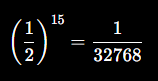
or about 0.003%. But there are multiple possible starting positions and either heads or tails can form the streak, which raises the overall probability to about 0.051% or 1 in just under 2000.
One surprising fact is that if you repeatedly conduct 20-flip experiments, the expected longest run is around 4 to 5 flips. That's why runs of 5 are common, runs of 10 are noteworthy, and runs of 15 feel shocking even though they still occur naturally in a fair random process.
This is a good example of how humans often underestimate the frequency of moderate streaks and overestimate the significance of very long ones. A run of 15 in 20 flips would certainly make people suspect a loaded coin, but statistically it's still something you'd expect to happen occasionally in a large enough collection of fair-coin experiments.
On the other hand, if you have a larger number, say 4, the chances that one of the 4 will go an exceeding long time before it is selected next is also fairly high. The higher the number in your selection (perhaps assigning work to a list of technicians) the higher the chance that one will go for a very long time between being picked and then (or overlapping) another goes a long time without being chosen is very likely.